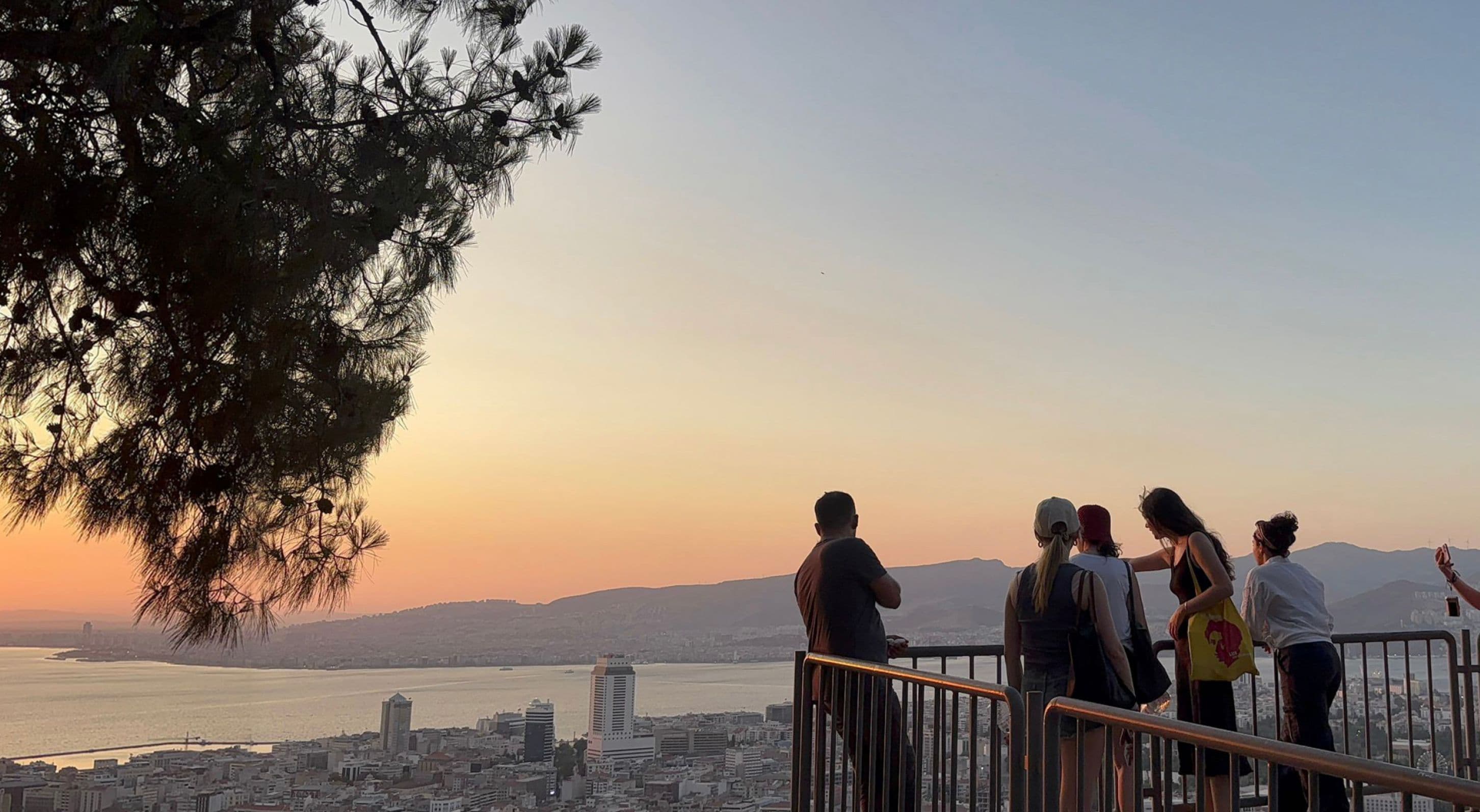
Observing the city from Mount Pagos during a collective walk at sunset, 2025In Other Latitudes examines the in-between spaces of Mediterranean port cities in the context of historical and contemporary conditions of urban politics. Located in the centre of Izmir, our visiting school views the recurring condition of displacement and its effects on the city. The historically migrant neighbourhoods surrounding Izmir’s Roman Agora continue to be the point of arrival in the city for contemporary refugees due to the construction of the train station in the 19th century. By looking at urban space within architectural, sociological, and political discourses, discussions on issues of identity, temporality, and informality are developed. Here, we will be facilitating points of contact and observing cultural products of migrants from within by examining the material conditions of social frameworks and their manifestations in architecture.
In the field, we are able to find intermediate spaces occupied and appropriated at different scales. Lectures and seminars will cover topics of displacement and resettlement, followed by relevant fieldwork in which the formation of architectural and social orders in the new domain will be observed. These studies will document local architectural and anthropological elements using recording methods, collection of objects, and mapping. The outcome will be a small-scale intervention derived from findings, exhibited together with a street dinner in the neighbourhood.
Aylin Gürel received her master’s degree from the AA, where she studied architectural theory and history. Her current research is on migration and displacement in relation to the built environment, visible in forms of cultural growth of societies, collective labor and art. Currently working as a visiting researcher for the UNESCO Chair on International Migration, her research examines histories and contemporary conditions of human movement as means for cultural processes and political expression.
Ömer Selvi is a city and transport planner. He completed his masters and doctorate at IYTE Department of City and Regional Planning and worked as a post-doc researcher for the EU Commission in Italy. He is a cofounder of the Kapılar project, a solidarity project that emerged in Izmir when the number of refugees reached its peak. He currently provides consultancy services for city and transport planning research and application projects.
Ege Mehmet Akman (co-ordinator) received his bachelors degree from Bogaziçi University's Department of Sociology and his masters degree from Sabanci University in Cultural Studies. His thesis concerned the politics of memory and the potentials of recent local counter-memory works on the discursive and spatial reconstruction of the cityscape through the memorialisation of the Great Fire of Smyrna and Izmir in 1922. He currently works as a research assistant at Istanbul Bilgi University's Department of Sociology.
Hosna Eqbal (co-ordinator)is an interdisciplinary artist based in Naarm (Melbourne), Australia, whose work explores the reciprocal relationship between art, architecture and the human spirit. She holds a masters in Architecture from the University of Melbourne and an Honours degree in Interior Architecture from Monash University. Self-reflexivity is central to her practice, woven through projects that bridge personal and collective memory. Her work investigates how comparisons with history, cultural traditions and the relationship between artisanal and architectural excellence should come into contact with intense emotional and poetic emotion on both large and small scales.
Jana Ahmad (co-ordinator) is a Syrian architect living in Izmir, currently pursuing her masters in Urban Regeneration. Her thesis explores climate change adaptation tools within historic cities, focusing on the multi-layered cultural landscape of the Bergama UNESCO World Heritage Site. Prior to her masters, she participated in interdisciplinary projects on historic urban fabric and post-war reconstruction in Syrian cities. Jana is interested in storytelling as a medium to explore urbanism and heritage.
The programme is open to graduate and undergraduate students, PhD candidates and young professionals interested in migration. Our multidisciplinary program is open to architecture as well as archeology, anthropology, history of art, migration studies, cultural studies, development studies and related fields.
A non-refundable £60 deposit is required from all applicants upon application and will be deducted from the total fees below:
Fees do not include flights or accommodation, but accommodation options can be advised. Limited spots for accommodation are available for participants at £240. For more information, please contact latitudes@aaschool.ac.uk.
A laptop is recommended for use during selected activities throughout the programme. Participants may bring any preferred materials for documentation, sketching or other media.