The Japan Study Programme is a design research platform connecting workshops across distinct geographical and cultural contexts: a rural post-agricultural village, an inner-city neighbourhood in Tokyo and a woodland fabrication workshop. Across these contexts, creative design emerges through cyclical relationships between objects, local knowledge, skills and stories, guided by direct observation and community engagement as an economy of means. The programme encourages active observation and individual creative responses to the social and cultural landscapes of Japan. The interlinking nature of these workshops allows new knowledge to emerge through encounters between contrasting conditions, bringing together notions of the global and the local – GLOCAL.
A workshop exploring neighbourhood life and cultural infrastructures within the historic district of Kagurazaka, Tokyo.
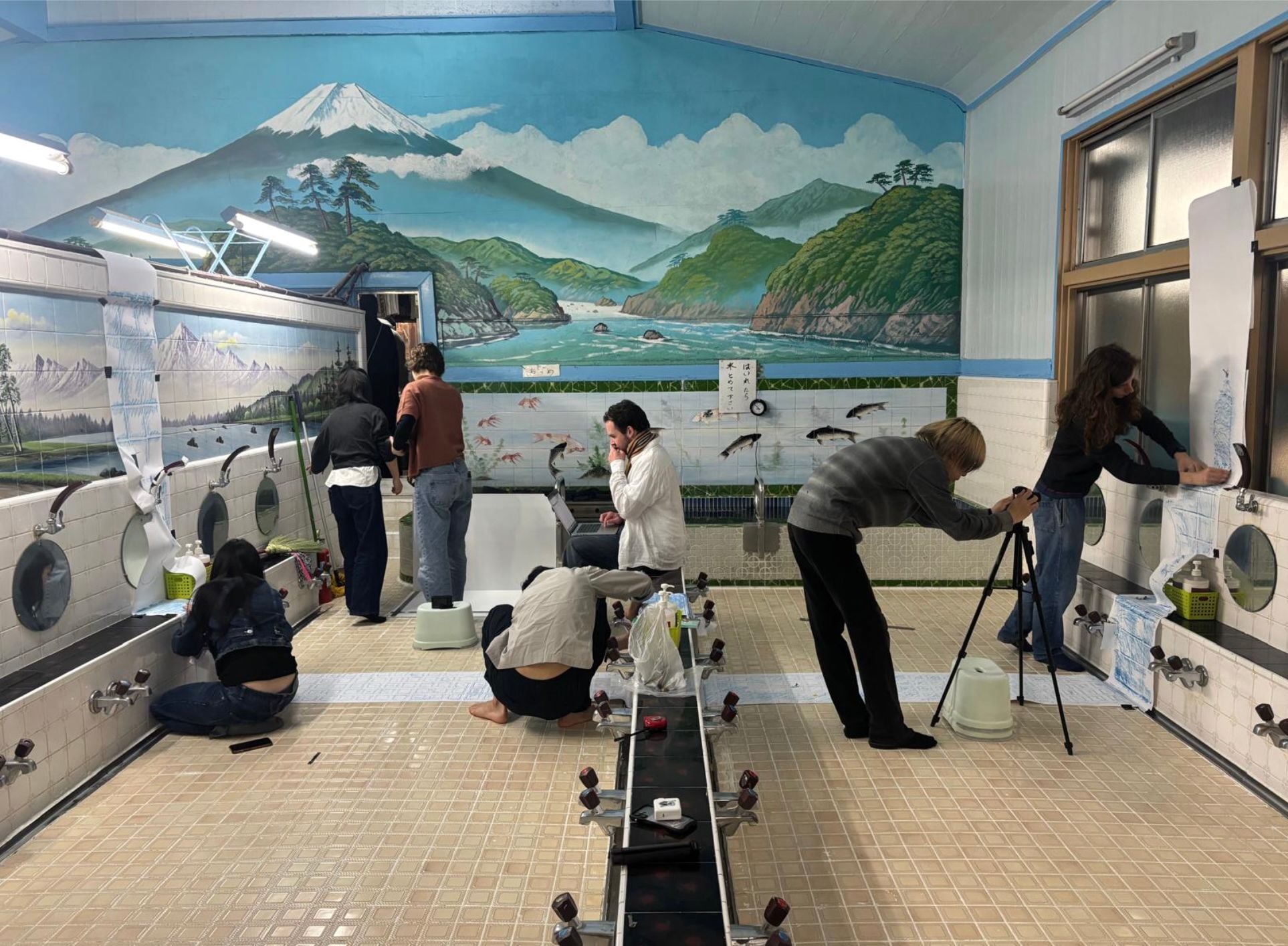
Just behind the busy main street of Kagurazaka stands Atamiyu, an old neighbourhood bathhouse. The community around it forms part of the historic fabric of Kagurazaka in the heart of Tokyo. Once serving not only practical needs but also the social rhythms of everyday life, Atamiyu is now one of many disappearing public bathhouses, quietly anchoring the neighbourhood’s networks.
The first Kagurazaka workshop will involve simple acts of observation and participants will focus on the subtle relationships that bind spaces, buildings and everyday life. Walking through the district reveals how these rhythms sustain the urban fabric and its complex urban ecology. Long-term residents, temporary populations and short-term visitors coexist, sustaining vitality while creating subtle tensions. Within this equilibrium, places like Atamiyu function not merely as services but as social anchors, quietly maintaining everyday relationships.
Building on this experience, the second workshop proposes a simple experiment: Kagurazaka Open School. For one week, the neighbourhood becomes a classroom. Streets and alleys form routes of exploration; vacant spaces temporarily become studios; local shops and institutions act as points of encounter. Students, researchers, practitioners and residents move together through observation, conversation and small acts of making. The workshop seeks to reveal the relationships that sustain the district and imagine ways such cultural infrastructures might continue to thrive.
In this sense, education becomes less about transferring knowledge than creating time and space for dialogue. When learning unfolds within the everyday life of the city, new connections emerge – and for a brief moment, the city itself becomes a school.
Participants are encouraged to also join the preceding workshop, Koshirakura Landscape Workshop: Post-Agricultural Community.
In association with Maeda Corporation as a core design research partner, the programme works with a range of cultural and civic institutions.
 The Rite of Seasons: Spring Making Workshop
 Unreal Worlds
 Forest Town and Furniture Making
 Earthbound Social Sculpture with Not Vital