Ripple Ripple Rippling
Ripple Ripple Rippling
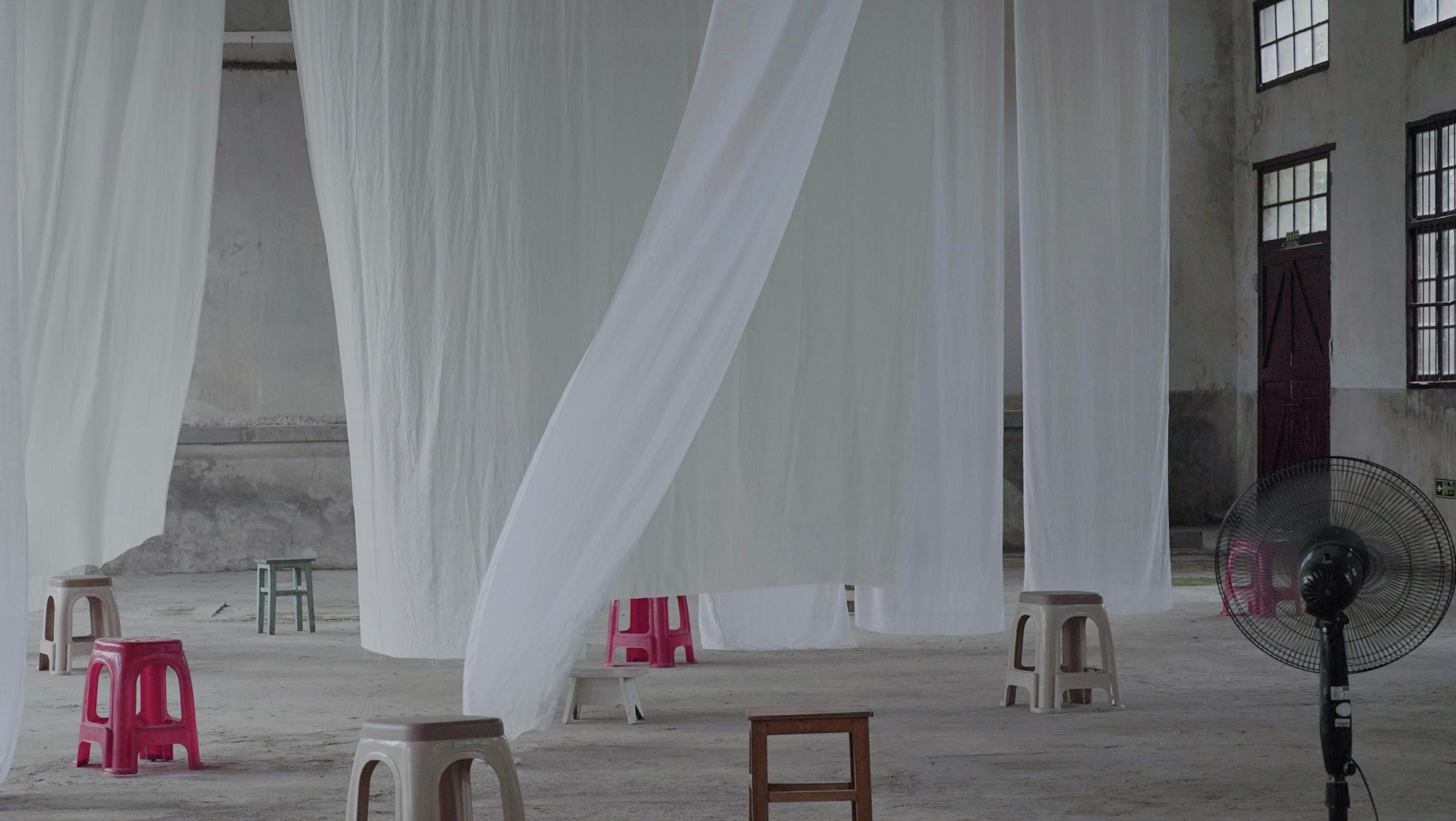
This multisensory exhibition tells situated stories of the entangled flows of people and land around an ordinary village in China. Curated visual, sonic and bodily encounters surface hidden changes in Chinese rural homes and village landscapes that enable the floating labour force who sustain the country’s urbanisation. The exhibition also reveals how the transformative process of this work has unfolded over a decade, and reflects on its evolving methods and media of communication, which interweave architecture, anthropology, filmmaking and performance.
Ripple Ripple Rippling has been working with Shigushan village, on the outskirts of Wuhan in China, since 2015. As a site of both labour supply and resource extraction, Shigushan’s life and landscape embody the social and ecological dependences embedded within China’s urbanisation. Its villagers are part of the country’s 295 million-strong rural migrant workforce, known as the floating population. These workers go to cities to work, leaving their ageing parents and young children behind; for more than 80% of families in rural China, the middle generation is missing. From tactics of dissolving their families and floating dynamically between cities and the home village emerges a practice of ‘rippling’. That is, forming indeterminate and resilient assemblages that stretch spatially from house to territory, co-ordinate temporally from daily to multi-year cycles, and manifest as bodily dispositions in everyday life. Through a situated perspective focusing on the home village, the project attunes to how villagers make worlds, from the opportunistic reparation of scarred landscapes to networks of care that extend and transgress familial bonds.
Over the past decade, Ripple Ripple Rippling has become a living project. From architectural documentation to participant observation to performative improvisation to collective happening, the project is a long-term commitment to a place, its marginalised community and their agency, resistance and complicity, all rooted in precarity.
After a journey that has expanded outwards from architecture, the exhibition at the AA is a moment of homecoming to the place where this project originally began. A work-in-progress house foundation at 1:1 scale on Bedford Square juxtaposes a key material register of the complex social and economic conditions in the village onto this privately-owned public space in central London – all while providing a stage for performances and food-sharing as well as a living garden. The corresponding exhibits in the AA Gallery include a walk-around screening of the Ripple Ripple Rippling film trilogy, and multimedia storytelling that brings together drawings, photographs and field footage.
11 October – 7 December 2024
Location
AA Gallery, 36 Bedford Square
Programme
Biographies
Jingru (Cyan) Cheng works across architecture, anthropology, and filmmaking. Her practice follows drifting bodies – from rural migrant workers to forms of water—to confront intensified social injustice and ecological crisis. Cyan was awarded the Harvard GSD’s 2023 Wheelwright Prize for TRACING SAND; received two commendations from the RIBA President’s Awards for Research in 2018 and 2020; and won the Architecture Short Film Award at the Milano Design Film Festival in 2024 and the Best Short Film at the Venice Architecture Film Festival in 2023, all as part of RIPPLE RIPPLE RIPPLING. Cyan’s work has been exhibited internationally, as part of Critical Zones at ZKM Karlsruhe, Germany (2020-22) and Venice Architecture Biennale (2018), among others. Cyan holds a PhD by Design from the Architectural Association and currently teaches at the Royal College of Art in London. She is also a Canadian Centre for Architecture’s CCA-Mellon Multidisciplinary Researcher (2024-25) on field research as a land-dependent practice.
Chen Zhan is an architect, anthropologist and independent filmmaker, trained at the AA and SOAS University of London respectively. As a UK registered architect, Chen worked on various award-winning projects across scales and sectors internationally, including the Maggie’s Cancer Care Centre in Leeds, UK. Chen uses film as a collaborative medium to conduct long-term research-oriented projects, winning the Architecture Short Film Award at the Milano Design Film Festival in 2024 and the Best Short Film at the Venice Architecture Film Festival in 2023. Her projects include ORCHID, BEE and I, a fictional ethnography that reflects on personal and collective experiences of living through the climate crisis and the Covid pandemic, and RIPPLE RIPPLE RIPPLING. Chen is currently part of the Canadian Centre for Architecture’s CCA-Mellon multidisciplinary research group—In the Hurricane, On the Land—looking into field research as a land-dependent practice.
Mengfan Wang is an independent theatre director and choreographer, with training in History of Art at the Central Academy of Fine Arts, Beijing, and Dance Studies at the Hochschule für Musik und Tanz, Cologne. Seeking to explore performative expressions of ordinary people, her dance theatre practice engages middle-aged women and children through a collaborative rework of daily acts and recently focuses on ageing bodies by working with retired ballet dancers. Mengfan is selected as 'Dance Hopeful (Hoffnungsträger)' by German dance magazine tanz in its yearbook 2018. Her dance works have been invited to VIE Festival Bologna, Beijing Fringe Festival, Wuzhen Theater Festival, among others. Commissioned by the Centre Pompidou and the West Bund Museum Shanghai, her latest work Narrative Fountain was shown as part of Women in Motion 2023. Mengfan’s artist residencies span across Shanghai, Berlin, Copenhagen and Zurich, including working with Theatre HORA supported by the Swiss Arts Council.
Support
The project has been awarded a Graham Foundation Production Grant (2024–25), following a Graham Foundation Research Grant (2022–23). The initial documentary phase was supported by the Driving the Human initiative (2021). Fieldwork between 2018 and 2019 was enabled by the Collective Forms in China project funded by the British Academy. The AA Wuhan Visiting School (2015–17), co-led by Sam Jacoby and Jingru (Cyan) Cheng, was a collective effort in the research with the help of all the participating students and tutors, and received local support from Huazhong University of Science and Technology School of Architecture and Urban Planning, co-ordinated by Dean Professor Gangyi Tan.
Supported by the Graham Foundation for Advanced Studies in the Fine Arts and Huazhong University of Science and Technology School of Architecture and Urban Planning.
Outdoor installation with in-kind support from Haysom Purbeck Stone the Building Crafts College and Ty-Mawr Lime. Built by Richard Gray and Tim Mason in collaboration with Max Higgins, Jonah Rollason and Laura Stargala.